Visiting timetableClosed
|Monday, October 12, 202677 Rue de Varenne, 75007 Paris, France
Back to masterworks
the-thinker
Rodin’s The Thinker: Versions, Patinas, Optics
How The Thinker moved from the Gates of Hell to standalone greatness, and why versions, patinas, and viewing distance matter.
12/22/2025
16 min read
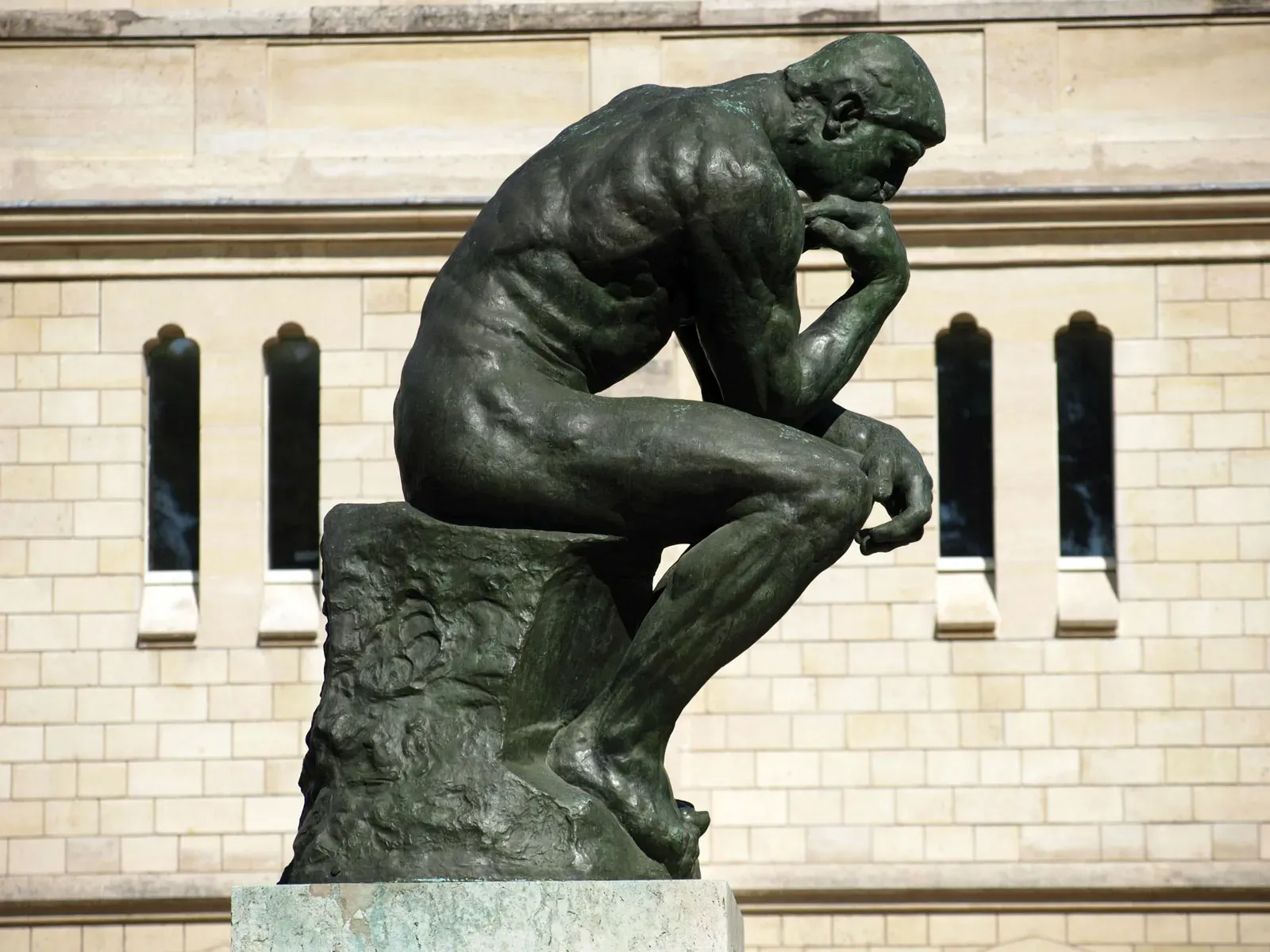
    Originally **Dante‑like** atop the **Gates of Hell**, **The Thinker** became a freestanding portrait of **concentrated energy**—a torque behind the eyes.

    ---

    ### Gesture & Anatomy

    - Weight shifts to the **right elbow**; spine **spirals**.
    - Compressed **rib cage** meets tense **thighs**.
    - Hands stage **mind as muscle**.

    > Thought is not airy here—it is **anatomy under load**.

    ---

    ### Versions & Patinas

    - Sizes: **petit**, **moyen**, **monumental**.
    - Patinas: deep **brown**, olive, **green**—each rewrites **light**.
    - Foundry marks and casting dates anchor **provenance**.

    | Variant | Height | Typical Setting |
    |---|---|---|
    | Small | ~70 cm | Interior galleries |
    | Medium | ~120 cm | Halls & niches |
    | Large | ~180 cm | Gardens & plazas |

    ---

    ### Optics Cheat Sheet

    Legibility (L) under daylight (E) with distance (d):

    $$L propto rac{E}{d^2}$$

    Closer, **glancing angles** reveal **tool marks** and **tendon transitions**.

    ---

    ### Where to Stand

    - 3/4 view, slightly **below eye level** → silhouette **tightens**.
    - Oblique sunlight → **patina gradients** read like **time**.

    See it on the **garden axis**—a thought poised to **spring**.

    ---

    ### Context & Background

    - The figure **originated** as part of the **Gates** ensemble (upper register).
    - Early casts vary in **scale** and **surface chase**—watch for **foundry stamps**.
    - Public placement shaped its **iconography**: a **thinking body** in civic space.

    ---

    ### Deeper Dive: Torque & Thought

    Rodin turns **cognition** into **mechanics**—spine, ribs, and wrists collaborate in a **spiral torque**. Bronze’s **memory** of the tool embeds **time** into surface; your eye reads **process** as **presence**.

    ---

    ### Quick Facts

    | Item | Detail |
    |---|---|
    | Origin | Gates of Hell (c. 1880s) |
    | Material | Bronze (versions), plaster studies |
    | Patina Range | Brown, olive, green |
    | Best View | 3/4, low eye level |

    ---

    ### FAQs

    - **How many versions exist?** Multiple foundry casts over decades, each **documented**.
    - **Is patina original?** Patina is a **finish**; conservators preserve **stability** over exact color.
    - **Why so muscular?** Rodin emphasizes **effort**—thinking as **action**.

    ---

    ### Pro Tips

    - Compare **small vs large** casts to feel **scale’s** effect on silhouette.
    - On **cloudy days**, step closer to read **tool marks**.
    - Note **finger joints**—they carry **thought weight**.
About the Author

Modern Sculpture Guide
As an art lover and Paris flâneur, I created this guide to help you experience Rodin’s world — from the rough vitality of clay to the quiet glow of marble.
Tags
The Thinker
Bronze
Patina
Foundry
Optics
Comments (0)
Leave a Comment
Loading comments...