Visiting timetableClosed
|Monday, October 12, 202677 Rue de Varenne, 75007 Paris, France
Back to masterworks
burghers-of-calais
Rodin’s Burghers of Calais: Empathy & Scale
A guide to Rodin’s Burghers—hands as speakers of fate, equal dignity among figures, and proximity over pedestal.
12/18/2025
17 min read
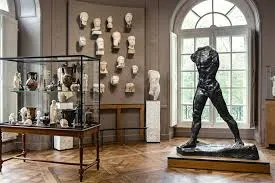
      Six figures, **no pedestal**. The monument becomes **encounter**.

      ---

      ### Innovations

      - **Equal dignity** among individuals.
      - **Hands** speak **fate** as much as faces.
      - **Ground‑level** display—civic memory via **proximity**.

      | Focus | What to notice |
      |---|---|
      | Drapery | Weathered weight |
      | Faces | Varied resolve |
      | Hands | Speech without words |

      > Courage looks like **uncertainty** that still walks forward.

      ---

      ### Context & Background

      - Commission tied to **historical sacrifice** and **municipal identity**.
      - Rodin resisted **heroic pedestalism** in favor of **human scale**.
      - Casts vary in **patina** and **site height**.

      ---

      ### Deeper Dive: Proximity & Empathy

      At ground level, you meet **eyes**, **hands**, and **weight**—not abstraction. Drapery feels like **weather** made visible; gestures carry **ethical load**. Rodin turns civic memory into **shared space** rather than **spectacle**.

      ---

      ### Quick Facts

      | Item | Detail |
      |---|---|
      | Group | 6 individuals |
      | Display | Often ground‑level |
      | Material | Bronze |
      | Best Reading | Circle figures, pause at hands |

      ---

      ### FAQs

      - **Why so somber?** It honors **grave decision** without theatrics.
      - **Where to start?** Find the **perimeter** and walk **slowly**.
      - **Are copies identical?** Foundry and patina differences shape **light**.

      ---

      ### Pro Tips

      - View each figure **solo**, then the **ensemble**.
      - Photograph hands in **soft light**.
      - Compare height differences across **sites**.
About the Author

Art Historian
As an art lover and Paris flâneur, I created this guide to help you experience Rodin’s world — from the rough vitality of clay to the quiet glow of marble.
Tags
Burghers of Calais
Empathy
Monument
Group
Civic
Comments (0)
Leave a Comment
Loading comments...